
The Cold War Ends
CMS creates the Office of Health Technology and Products, consolidating its standards agenda under a chief product officer and a single chain of command

If you had said to me when I was in college, “Brendan, in a few years, you’re going to be studying federal org charts like you’re drafting dynasty league players for fantasy football”, I would have had serious questions about your sanity. And yet, here we stand (yet again, I guess)
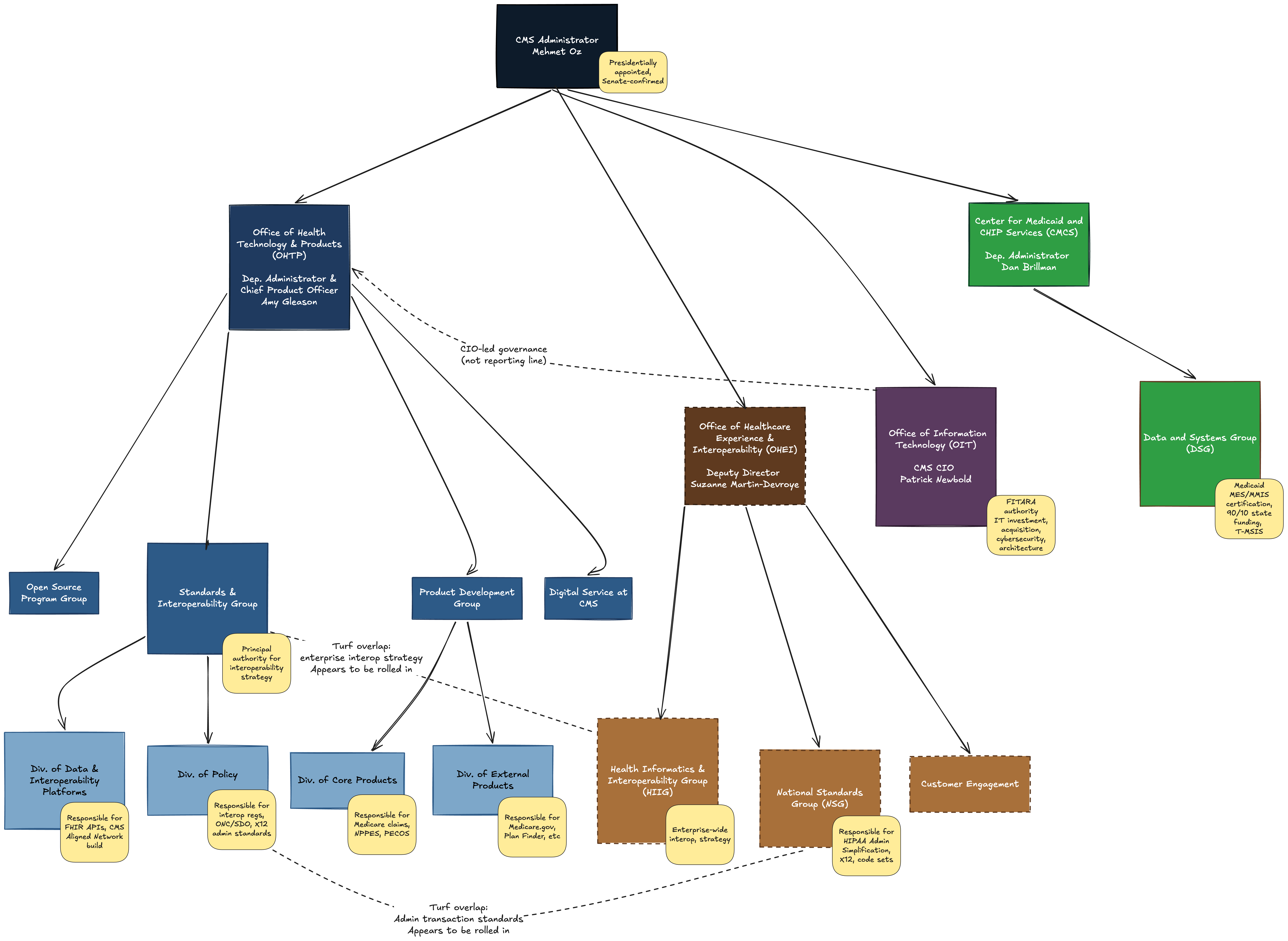
On June 9, CMS underwent a major modernization-oriented reorg and stood up the Office of Health Technology and Products. And thus we can stop the count, as the intra-agency cold war is largely over.
The Change
First, what actually happened. OHTP is new four groups under one deputy administrator:
Open Source Program Group: Writes and enforces CMS/HHS open-source policy, including the M-16-21 mandate to release at least 20% of new custom code as open source
Standards and Interoperability Group: Owns CMS interoperability strategy, policy, and standards, pushing API-based exchange while maintaining the legacy administrative transactions.
Division of Data and Interoperability Platforms: The build shop. Ships the FHIR APIs and data-exchange platforms (read: the CMS Aligned Network), runs the pilots, validates what works.
Division of Policy: The pen. Writes the interop regs and sub-regulatory guidance, coordinates with ONC and the SDOs, and evolves the X12-era transaction standards, code sets, and identifiers.
Product Development Group: Delivers the full CMS digital product portfolio end to end, applying modern product management and agile practices.
Division of Core Products: Runs the internal and enterprise platforms everything else depends on, including Medicare claims and payment processing and the provider directory stack (NPPES, PECOS).
Division of External Products: Owns the beneficiary- and public-facing products, headlined by Medicare.gov and the Plan Finder.
Digital Service at CMS: The internal strike team. Runs short discovery sprints and surge capacity for high-priority projects, then hands recommendations back to business owners. (This is the formalized DOGE/USDS work.)
Somewhat obviously, this is the CMS Health Tech Ecosystem getting a hierarchy and shuffling much of what existed previously under it. The voluntary pledge drive that was meant to outpace TEFCA’s consensus clock just stopped being a side project and became a line on the org chart, with staffing, a mandate, and a deputy administrator. OHTP is what happens when an initiative graduates to institution.
The New Hierarchy
If that reads like a tech company’s org chart, I agree with your assessment.
