

Been thinking about market segmentation and patterns of investment in AI at the application layer. I'm sure someone deeper in the weeds in that area has better categorization than this, but adding to the dialogue.
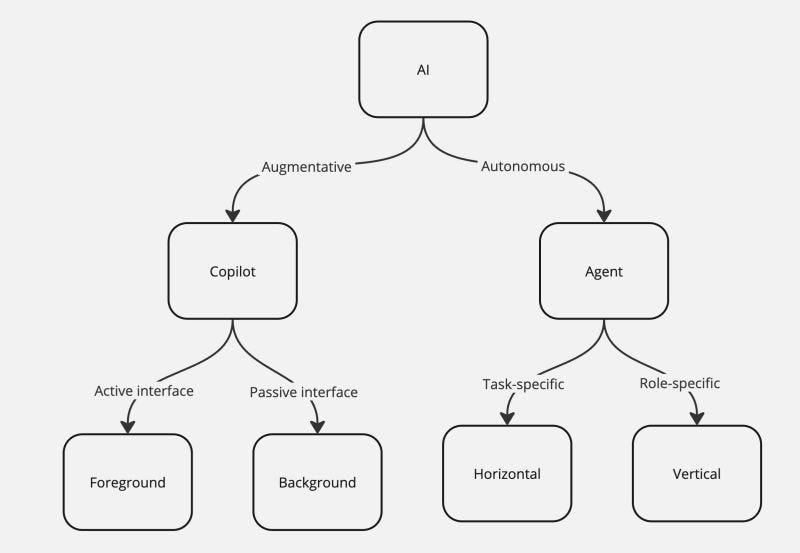
Overall, AI is roughly divisible into augmentative and autonomous tools.
Augmentative tools are the ones that improve worker productivity - if each employee is doing X, these tools aim to get them to 10X. ChatGPT, Claude, Github Copilot, and most “copilots” in general fit in this category. People are generally very positive on this category.
Beyond that, we can segment the tools into active and passive interfaces. Tools like ChatGPT or some of the buzz of Oracle's new EHR (where navigation occurs via AI-parsed voice) slot in here as active interfaces. You choose to engage in the foreground
Passive interfaces are the ones that listen/watch what's happening in the background and use AI to organize that information & perform tasks. The relentless tide of AI notetaker bots are this for Zoom calls, teeing up next steps and sending emails. Ambient scribes do this in healthcare, transcribing provider-patient conversations into structured notes, placing orders, adding diagnoses and more.
Autonomous tools are ones that replace roles altogether. This is the category that scares people and stirs up a lot of fear, uncertainty, and doubt. Salesforce and other companies are referring to these as agents. These are difficult to create in healthcare due to licensure/other regulatory protections.
The two subcategories here are based on whether these agents replace in a task-specific or role-specific way. Task-specific (or horizontal) agents act like residents do - taking on lower-level, more basic tasks and allowing people to perform at top of license. There's apprehension in that such agents will remove easy work and increase burnout by only having high intensity/difficulty problems at all times.
Role specific (or vertical) agents will replace the entirety of roles - for instance, perhaps behavioral health will be the first specialty to allow a fully autonomous provider, while other specialties remain human-oriented. These feel the furthest off - there are regulatory barriers, but also the emotional and social ones.
In terms of upside, agents have a much higher expected value, but more challenges. Active interfaces are fun, but ultimately have some of the same problem as Siri - they require explicit engagement and cognitive overhead to use. This means their adoption and impact often fall short of expectations - users must actively remember to use them and overcome the friction of engagement.
So we see VC dollars flow towards passive interfaces - higher upside than active interfaces and safer investment than agents. I think some of the bets on agents will pay off big time, but have longer time horizons